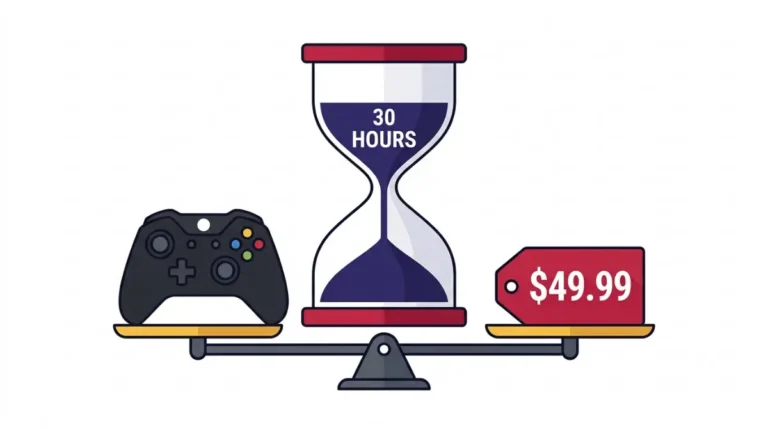
A Clear Way to Sort Games by Hours to Finish

Games sorted by hours to finish, and why Hades reads 23.5 hours in one source and about 15 in another.
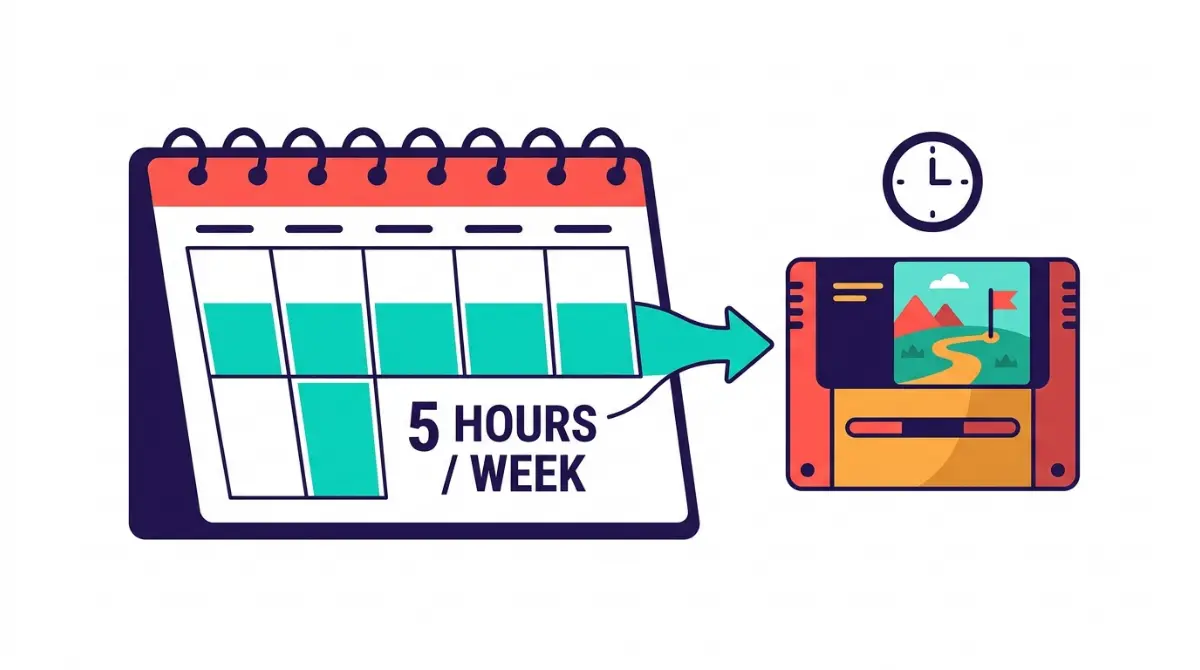
Table of Contents
🎟️ How we got it: Nothing here was reviewed from a copy. No publisher or platform gave us access, and nothing below depends on one.
Games like your favorite: pick by hours, not just genre
The short answer: match the feeling, then check the finish line
A game is only “like your favorite” if you will finish it. Match the feeling first, then match the length to your calendar.
⚖️ The Verdict: Pick the lookalike that fits inside about six weeks at your own weekly hours, and put anything longer on a later shelf. If your favorite took 50 hours and you play five hours a week, a shorter game with the same feel is a better use of your evenings than its full-length cousins. The six-week limit is our rule of thumb, not a measured statistic.
If time is your tightest limit, start with our list of the best short games sorted by evenings. This guide covers every length.
Find your row by the hours you have
- If you get five hours a week, multiply by six: your ceiling is about 30 hours, so start in the first three bands below.
- If your favorite took 60 hours or more, look for its feeling in a shorter game before you commit to a sequel.
- If the game is already in your library, check its hours against your pace in the pace table before you start it tonight.
- If you are waiting on a sale, read the cost-per-hour section first, then decide whether to wait.
Match the feeling, not the genre
Three steps find a lookalike without a genre filter:
- Name what you loved: the loop (short runs or long exploration), the mood, or the pace.
- Find games that share that one thing, even when the genre differs.
- Filter them by hours at your own weekly pace.
How to read hours to finish (and why sources disagree)
Before you trust any hour figure, know what it measures and who counted it.
The three HLTB numbers
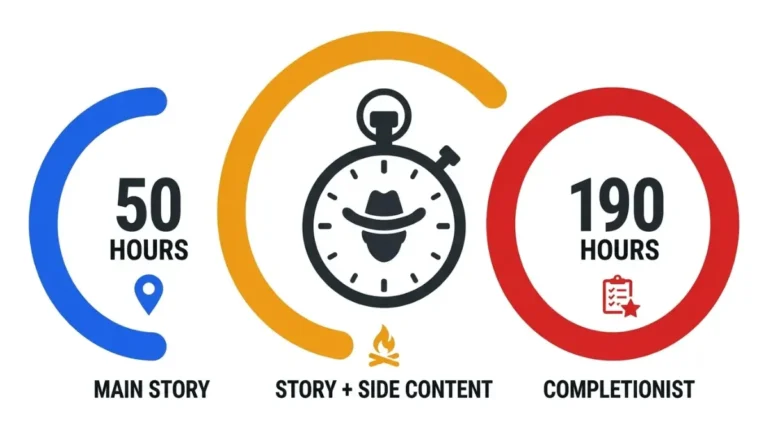
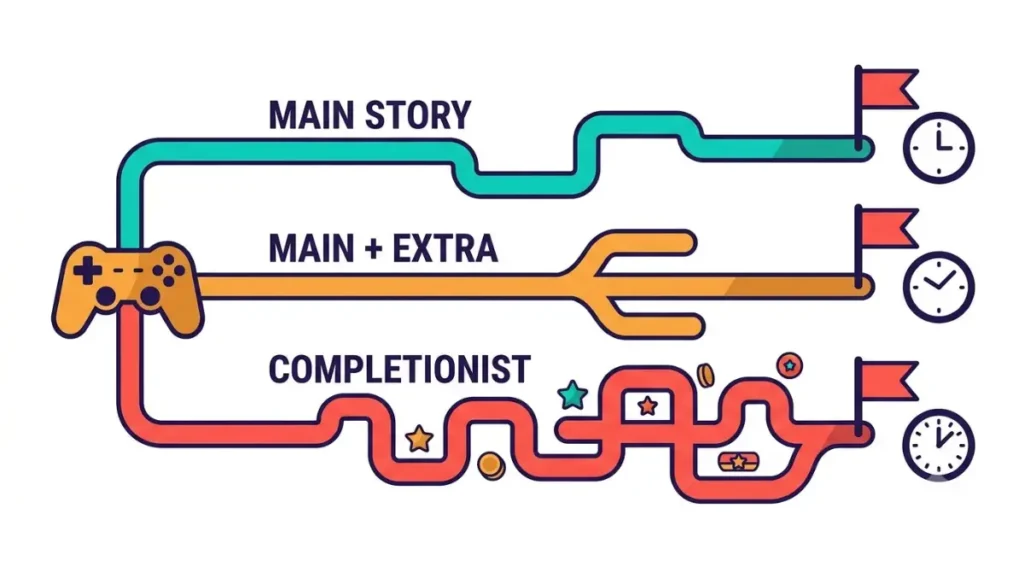
HowLongToBeat splits a game’s length into three crowd-submitted numbers:
- Main Story is the core path only. Use it for the minimum commitment.
- Main + Extra adds side content. Use it for a realistic full experience.
- Completionist covers everything. Use it only if you chase 100%.
What counts as average
These figures are community-submitted estimates, so they shift with who submits and how they define a finish. Posters in Steam discussion threads argue that “main story” and “100%” mean different things from one submission to the next. Treat any single number as a midpoint, and read how HowLongToBeat numbers hold up before you plan around it.
One game, three answers
Hades shows the problem. Per Supergiant’s official page, it is a rogue-like dungeon crawler, so “finished” can mean one successful run or the whole story.
| Source | Hades length | Note |
|---|---|---|
| HowLongToBeat, via DekuDeals | 23.5 hours main, 48.5 main plus extra, 95.5 completionist | Community-submitted |
| Twinfinite guide, dated 2020 | About 15 hours | Framed as an average that varies with skill and luck |
| RealSport101, updated February 2026 | 20 to 200 hours | Ties length to how many successful runs you need |
Figures are from the pages named, retrieved 9 October 2026. A Steam thread from before the 1.0 release cited HowLongToBeat at about 14.5 hours, so the numbers also drift over time.
⏱️ Time Check: Community completion data (HowLongToBeat, via a DekuDeals listing checked 9 October 2026) puts Hades at 23.5 hours for the main story. Treat that as a midpoint, not a promise.
What community data cannot tell you
It cannot tell you how long a session runs, how forgiving the saves are, or what a failed attempt costs you. Those decide whether 20 hours takes four weeks or ten.
How many weeks will a game really take you?
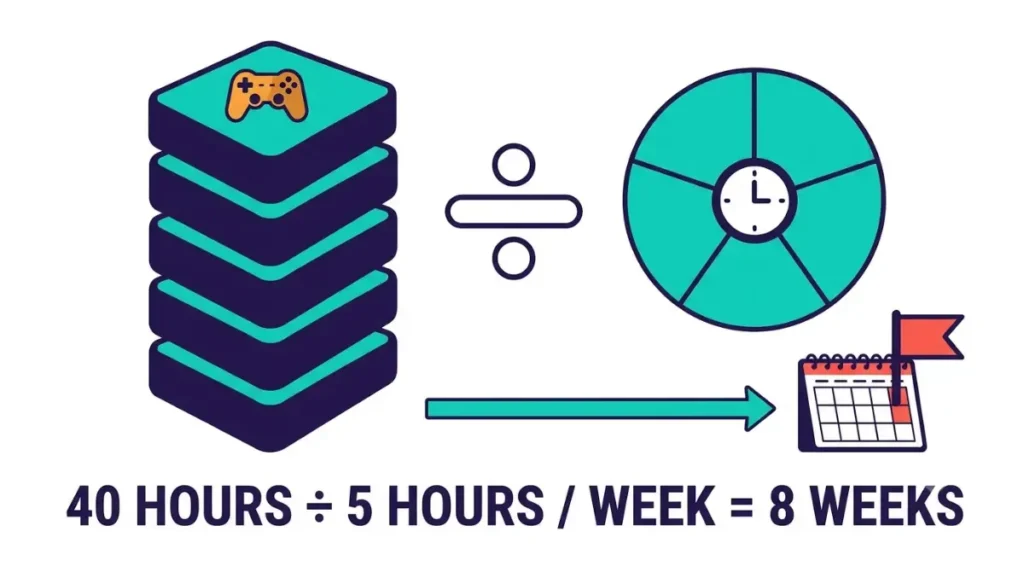
Your weekly hours turn any figure above into a finish date.
Start with your real hours
Count last month, not your plans. A pace you can keep beats a pace you hope for.
Hours to weeks
At five hours a week, a 40-hour game takes eight weeks (40 ÷ 5). A 20-hour game takes four. At three hours a week, the same 40 hours takes 13.3 weeks.
| Game length (hours) | 3 h a week | 5 h a week | 10 h a week | 15 h a week |
|---|---|---|---|---|
| 5 | 1.7 weeks | 1.0 | 0.5 | 0.3 |
| 10 | 3.3 | 2.0 | 1.0 | 0.7 |
| 20 | 6.7 | 4.0 | 2.0 | 1.3 |
| 40 | 13.3 | 8.0 | 4.0 | 2.7 |
| 80 | 26.7 | 16.0 | 8.0 | 5.3 |
Weeks to finish. Our arithmetic: game hours ÷ weekly hours, rounded to one decimal. It assumes you play every week.
💡 Worth Knowing: A two-week gap adds two weeks, and a game that is hard to pick up again after a break adds more. If you only get 30 minutes at a time, look at games built for short play sessions.
The six-week rule
Multiply your weekly hours by six. That is your ceiling for a game you start tonight: 18 hours at three hours a week, 30 at five. It is our rule of thumb for keeping a game within reach, not a result from any study.
Games like your favorite, sorted by hours to finish
Pick the band that fits your six-week ceiling, then read the “feels like” line to see if it matches what you loved. Hours are HowLongToBeat main-story figures as shown on DekuDeals listings checked 9 October 2026, which are community-submitted estimates.
“Feels like” lines paraphrase publisher descriptions. We have not played any of these for this article, so none is marked as played. We list only games whose hours we checked, so some bands are thin.
Under 6 hours
A Short Hike (Switch, PlayStation 4, Xbox One, PC): 1.5 hours main story, about one evening at five hours a week. Feels like unhurried exploration of a small park with no pressure to rush the summit. Skip it if you want many hours of content.
6-12 hours
Celeste (Switch, PlayStation 4, Xbox One, PC): 8.5 hours, about 1.7 weeks at five hours a week. Feels like precise platforming where fast respawns keep you retrying. Skip it if repeating hard jumps sounds like a chore. If you only have a weekend, see our games you can beat in a weekend.
12-25 hours
| Game | Feels like | Hours (main, community) | Weeks at 5 h a week | Skip if |
|---|---|---|---|---|
| Super Mario Odyssey (Switch) | Playful collect-and-explore platforming across many worlds | 12.5 | 2.5 | You do not own a Nintendo Switch |
| Dead Cells (Switch, PlayStation, Xbox One, PC) | Fast action runs where some progress carries over | 14 | 2.8 | Losing a run on death annoys you |
| Hades (Switch, PlayStation, Xbox, PC) | Short escape attempts with story unfolding between them | 23.5 | 4.7 | You want a fixed, short campaign |
25-50 hours
Hollow Knight (Switch, Switch 2, PlayStation, Xbox, PC): 27 hours, 5.4 weeks at five hours a week. Feels like a wide, interconnected world you explore your own way. Skip it if you dislike exploring without a clear path.
50 hours and up
| Game | Feels like | Hours (main, community) | Weeks at 5 h a week | Skip if |
|---|---|---|---|---|
| The Legend of Zelda: Breath of the Wild (Switch) | A huge open world you can tackle in any order | 50.5 | 10.1 | You only have a few hours a week |
| Stardew Valley (Switch, Switch 2, PlayStation 4, Xbox One, PC) | Farming and town life; its 172.5-hour completionist figure shows how open-ended it gets | 53.5 | 10.7 | You want a clear finish line |
Shorter games with the same feel as a long favorite
Keep what you loved and cut the hours with a swap, not a genre match.
Same feel, half the hours
Three swaps that cut hours, using community main-story figures: A Short Hike (1.5) for Stardew Valley (53.5), Dead Cells (14) for Hades (23.5), and Hollow Knight (27) for Breath of the Wild (50.5).
| Long favorite | Shorter cousin | What carries over | What you may give up |
|---|---|---|---|
| Stardew Valley, 53.5 h | A Short Hike, 1.5 h | Calm, low-pressure exploration | Farming and long-term building |
| Hades, 23.5 h | Dead Cells, 14 h | Action runs where progress carries over | The character-driven story Hades puts at its center |
| Breath of the Wild, 50.5 h | Hollow Knight, 27 h | Choosing your own path | The scale of a 3D open world |
Hours: HowLongToBeat community figures via DekuDeals, 9 October 2026. “Carries over” paraphrases publisher descriptions. We have not played these, so the right-hand column is a judgement from those descriptions, not from play.
For a mood-first match, see our guide to games like Journey you can finish in one night.
Sequel or lookalike
Supergiant’s page lists a sequel, Hades II, next to the original. A sequel is the surest match for feel, but it is not always shorter, so compare their HowLongToBeat figures before you buy.
When the extra hours earn their place
Hades runs 23.5 hours for the main story and 95.5 for completionists, a gap of 72 hours. That gap is community data about finishing everything, not a measure of quality, and we have not played enough to say whether those hours earn their place. If your time is short, plan around the first number.
Is it worth buying now? Cost per hour and when to wait
Price per hour is a better yardstick than price, though neither tells you whether you will enjoy a game.
The formula
Cost per hour is the price divided by the hours you expect to play. Hades at $24.99 over 23.5 community-reported main-story hours is about $1.06 an hour.
Cost per hour, worked
💰 Value Math: Prices are Nintendo eShop-based listings shown on DekuDeals on 9 October 2026, a third-party tracker. Hours are HowLongToBeat community figures. Other platforms may price differently.
| Scenario | Price | Hours | Cost per hour |
|---|---|---|---|
| Hades, listed price | $24.99 | 23.5 main story | $1.06 |
| Hades, listed price | $24.99 | 48.5 main plus extra | $0.52 |
| Hades, digital low on the page | $6.24 | 23.5 main story | $0.27 |
| Celeste, full price | $19.99 | 8.5 main story | $2.35 |
| Celeste, listed sale | $4.99 | 8.5 main story | $0.59 |
A short game at full price can cost more per hour than a long one: Celeste at $19.99 is $2.35 an hour, against $1.06 for Hades. For more on this, see cost per hour for short and long games.
🔄 Last Verified: 9 October 2026. Prices and sales change often; check the storefront before you buy.
Subscription or buy
If a game sits in a subscription library you already pay for, such as Game Pass, playing it adds almost nothing to your cost per hour. Catalogues rotate, so check before you plan around it.
✅ Do This: Search your subscription’s library for the game before you buy it.
When to wait for a sale
Cost per hour measures length, not quality, and a game you do not finish costs its full price per hour.
When we checked, Celeste was listed at $4.99, 75% off, with the sale due to end within a day, close to the $3.98 all-time digital low DekuDeals shows. If that sale has ended, check the price history before paying full price.
Hades was at its full $24.99 listing, so waiting is the saver’s move, though it is already about $1.06 an hour.
Where to put it in your backlog so you actually finish
Where a game sits in your queue decides whether you finish it.
Three shelves by weeks to finish
Sort each game by weeks at your pace. This month is six weeks or fewer, this season is six to twelve weeks, and parked is anything longer.
| Weekly hours | This month (6 weeks or fewer) | This season (6-12 weeks) | Parked |
|---|---|---|---|
| 3 h | Up to 18 h | 18-36 h | Over 36 h |
| 5 h | Up to 30 h | 30-60 h | Over 60 h |
| 10 h | Up to 60 h | 60-120 h | Over 120 h |
| 15 h | Up to 90 h | 90-180 h | Over 180 h |
Our arithmetic: weekly hours × 6 and × 12.
At five hours a week, Celeste, Dead Cells, Hades and Hollow Knight fit this month. Breath of the Wild and Stardew Valley belong on this season.
Buy less, finish more
Buy a game when a shelf has room for it. If a long RPG already holds your “this season” shelf, a short palate cleanser between RPGs keeps you playing without adding weeks.
When to drop a game
Dropping a game is a valid outcome. If you are hours in and dreading the next session, you have learned what you needed, and the time you save goes to the next shelf. Read is it okay to quit a game if guilt is the sticking point.
✅ Do This: Pick one game for “this month” and move the rest down a shelf.
Games like your favorite by length: quick answers
1. What is the difference between main story, main plus extra and completionist?
Main story covers the core path, main plus extra adds side content, and completionist covers everything. All three are community-submitted estimates from HowLongToBeat.
2. Is HowLongToBeat accurate?
It is a community estimate, so it shifts with who submits and how they define finishing. Treat it as a midpoint, not a promise.
3. Why do sites give different lengths for the same game?
Sources define finishing differently and update at different times; for Hades we found about 15, 20 to 200, and 23.5 hours.
4. How do I find games like my favorite game?
Name what you loved, such as the loop, mood or pace, find games that share it, then filter by hours at your pace.
5. How long does a 40-hour game take at 5 hours a week?
Eight weeks, because 40 divided by 5 is 8. At three hours a week the same game takes about 13.3 weeks.
6. How do I calculate cost per hour for a game?
Divide the price by the hours you expect to play, using main story or main plus extra. Our worked examples above show both.
7. Is a game worth full price based on length alone?
No. Length is not quality, so check cost per hour against the listed low price before buying.
8. Is Game Pass worth it for a few hours a week?
Only if you would play enough of its catalogue to beat buying individually; check its current price, which changes, against your cost per hour.
Your next step by weekly hours
The verdict has not changed: pick the lookalike that fits inside about six weeks at your pace. If time is tight, use our evenings-sorted short list. If a figure looks off, see how reliable HowLongToBeat is, and check the cost-per-hour math before you buy.