The Right Way to Judge Cost Per Hour Games, Short or Long

Cost per hour games flip fast: in our example, $70 over 70 hours is $1 an hour, but over 12 hours played it is $5.83. Where does yours land?
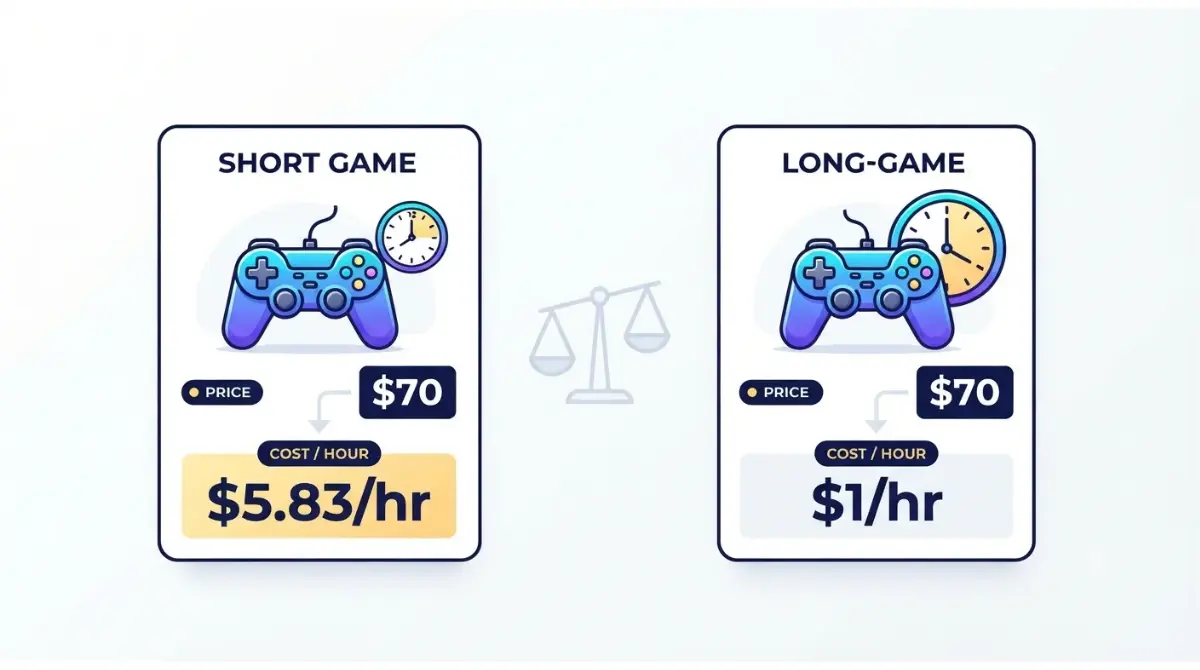
Table of Contents
Short vs long games: which costs less per hour?
On the sticker, long games cost less per hour; on your calendar, it can flip.
⚖️ The Verdict: Cost per hour is a tiebreaker, not a verdict. Judge a game by its price divided by the hours you will realistically play. A long game only wins if you will still be playing past its break-even hour; if that is a stretch, buy the shorter one.
Five hours a week? Try the pace table. Unplayed game? See the finish rates. Comparing prices? Start at the break-even table.
Long games win on the sticker
In our illustrative arithmetic, $70 over 70 hours is $1 an hour.
Short games win on what you play
The same $70 over 12 hours actually played is $5.83.
How to calculate cost per hour for a game
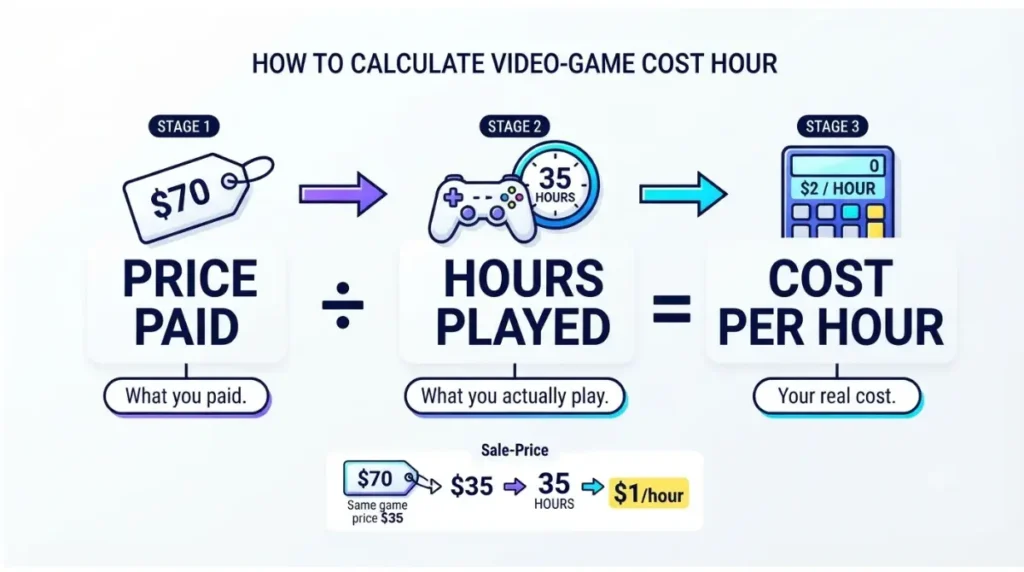
To calculate cost per hour, divide the price you paid by the hours you actually played, not the hours on the box.
The formula, in three steps
- Start with what you paid, including any sale discount.
- Use the hours you played, or realistically expect to play.
- Divide the price by the hours.
Using a sale price or adding DLC
Add any DLC to the price and its hours to the total, then divide again. Box hours usually come from HowLongToBeat, whose figures are community-submitted estimates, so treat them as a midpoint (how accurate HowLongToBeat is). To skip the math, use the Cost-Per-Hour Value Calculator.
How many hours does a $70 game need to beat a short one?
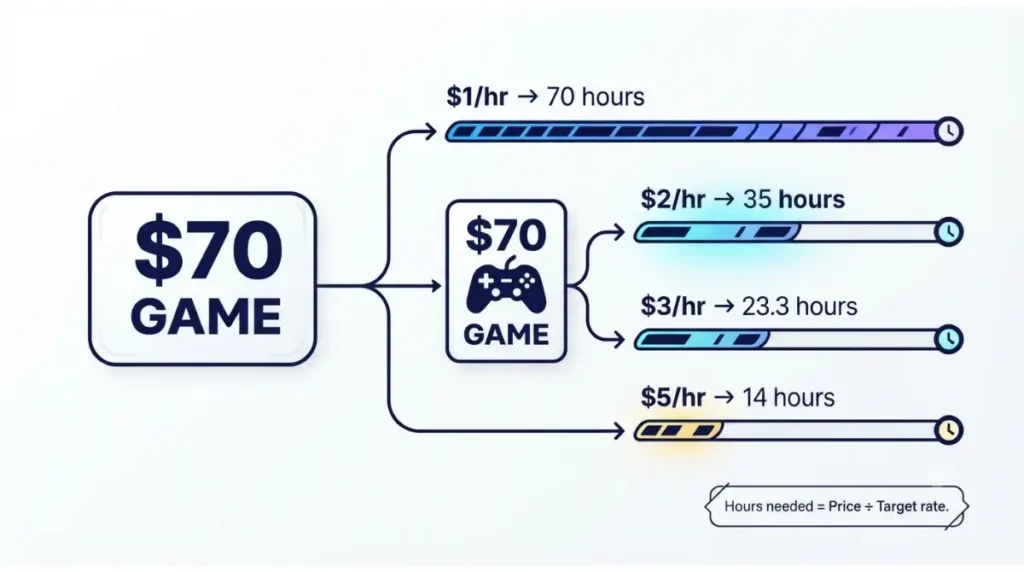
At a given cost per hour, the price tells you how many hours a game must be played to earn it. At $2 an hour, a $70 game needs 35 hours; at $5 an hour, 14.
The break-even table
| Price point | $1/hr | $2/hr | $3/hr | $5/hr |
|---|---|---|---|---|
| $20 | 20 | 10 | 6.7 | 4 |
| $40 | 40 | 20 | 13.3 | 8 |
| $70 | 70 | 35 | 23.3 | 14 |
| $80 | 80 | 40 | 26.7 | 16 |
Hours needed = price ÷ rate. Our own arithmetic; price points are illustrative, not current prices.
Picking your benchmark rate
⚠️ Watch Out: Forum “rules” of roughly $1 to $5 an hour are community opinion, not data. Choose your rate first, then read the price tag.
Do players actually finish long games?
Mostly not: a 2026 Two Average Gamers analysis of 19 single-player Steam games found a median of about 36 percent of owners reached the ending, with Steam undercounting true completion.
What the finish-rate data shows
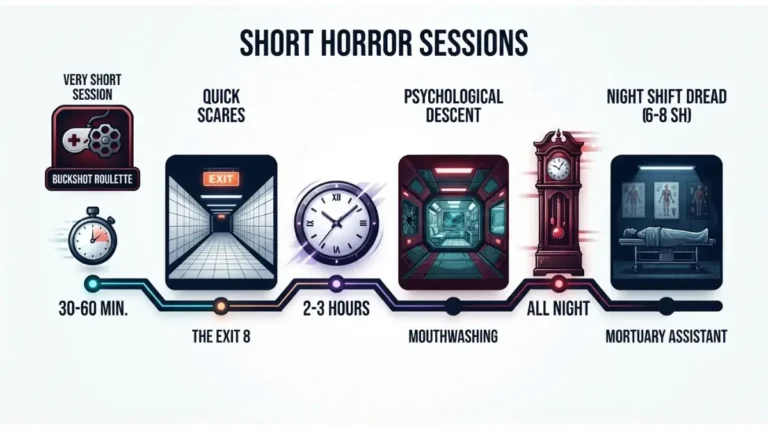
⏱️ Time Check: Steam’s public achievement data, checked October 3, 2026, shows about 75 percent of players reached the end of Mouthwashing, which HowLongToBeat’s community-submitted estimates put near 3 hours. Baldur’s Gate 3, near 73 hours on IsThereAnyDeal’s listing of HowLongToBeat’s figures, sits near 23.5 percent.
Why length alone doesn’t predict it
Two games prove nothing; digitec’s analysis called the link between length and finish rate tenuous. We claim only that box hours overstate hours played. We have not played either game; see whether Mouthwashing is worth it.
How long a game takes at 3, 5 or 8 hours a week
At 5 hours a week, a 40-hour game takes about 8 weeks.
Weeks to finish at your pace
| Game length | 3 hrs/week | 5 hrs/week | 8 hrs/week |
|---|---|---|---|
| 10 hours | 3.3 | 2 | 1.3 |
| 20 hours | 6.7 | 4 | 2.5 |
| 40 hours | 13.3 | 8 | 5 |
| 80 hours | 26.7 | 16 | 10 |
Weeks = hours ÷ weekly hours. Our own arithmetic; the weekly profiles are illustrative.
What that means for a full-price buy
At $70, the 40-hour row needs eight steady weeks to reach $1.75 an hour. Estimate your own finish date with the Realistic Completion Estimator.
✅ Do This: Before buying, lay the game’s length over your real weekly hours and ask whether you will still be playing at the finish date.
Buy now, wait for a sale, or subscribe?
Waiting for a sale cuts your cost per hour by the same percentage as the discount.
What waiting does to your cost per hour
Half price halves it: $70 for 35 hours is $2 an hour, and $35 is $1. Nintendo’s launch pricing announcement listed games at $79.99 and $69.99, so $70 to $80 is a fair list-price range. Check a price-history tracker such as IsThereAnyDeal first; if the math says wait, wait.
Subscribing: monthly fee ÷ hours played
Divide the monthly fee by the hours you play that month; if that beats your rate, subscribe. Catalogues rotate, so confirm the listing first.
🔄 Last Verified: October 3, 2026 — prices and catalogues change often; check the storefront before you buy.
When cost per hour misleads: other ways to judge value
PC Gamer has argued that cost per hour treats games as products, not experiences, and Vice called it a poor yardstick; fair points.
Where it flatters long games and punishes short ones
A padded long game can post a better figure than a tight short one while delivering less. Count replays only if you will actually do them.
Cost per evening, and which metric to use
Cost per evening is price divided by evenings played: $20 over three evenings is $6.67 each. Use cost per hour to compare similar games, and cost per evening when your time comes in small blocks.
Cost per hour games: quick answers
1. What is cost per hour for games?
Cost per hour for games is the price you paid divided by the hours you actually played, not the hours listed on the box.
2. How many hours does a $70 game need to be good value?
At $2 an hour a $70 game needs 35 hours; at $5 an hour it needs 14, so choose your rate first.
3. Is cost per hour a good way to judge a game?
Cost per hour is a useful tiebreaker, not a verdict: judge a game by price divided by the hours you will realistically play.
4. What is a good cost per hour for a video game?
No standard cost per hour exists; forum players range from about $1 to $5, which is opinion, so set your own.
5. Are short games worth full price?
Often, when you will finish it: a long game only wins on cost per hour if you play past its break-even hour.
6. Do most players finish the games they buy?
No: one 2026 analysis found a median of about 36 percent of Steam owners reached the ending across 19 games.
7. How do I calculate cost per hour with a sale price or DLC?
Use the price you paid, add any DLC cost and its hours, then divide the total price by the total hours played.
8. Should I wait for a sale on a long game?
Waiting cuts cost per hour by the discount: half price halves it, so check price history before paying list.
9. Is a subscription better value than buying?
Divide the monthly fee by hours played that month; if that cost per hour beats your rate, subscribe, and confirm the game is still listed.
10. How long does a 40-hour game take at 5 hours a week?
About 8 weeks; at 3 hours a week it takes about 13, and at 8 hours about 5.
The number to trust before you buy
Trust price divided by the hours you will really play, then compare it with the break-even hour. Next, see which short games fit your schedule in Best Short Games Sorted by Evenings, Not Just Hours.